
Intercessory Prayers & One Mediator for Salvation
The Meaning of Prayer, Intercession, and Mediation in 1 Tim 2:1–7

1 Tim 2:5 is a commonly abused text for arguing that requesting intercessory prayers from Mary and the Saints is inappropriate in Christianity. This is an obvious instance of contextomy, and it happens far too frequently to ignore.
In this article, I will provide a translation of the passage and then discuss the meaning of these verses. This will include talking about a few key words concerning prayer and the structure of the passage.
I will conclude with a brief explanation why this passage is irrelevant for condemning the Christian practice of praying for the dead or requesting intercessory prayers from Mary, the angels, and the saints.
Translation
|2:1| Then first of all, I encourage you to make petitions (δεήσεις), prayers (προσευχὰς), intercessions (ἐντεύξεις), and thanksgivings (εὐχαριστίας) on behalf of all men—|2| on behalf of kings and all who are in authority—so that they lead (διάγωμεν) a smooth and quiet life in all reverence and dignity.
|3| This is good and acceptable before our savior God, |4| who desires all men to be saved and to come to the knowledge of truth:
|5| For God is one,1
One also is the mediator for God and men,
The man Christ Jesus,
|6| The one who gave himself as a ransom (ἀντίλυτρον, hapax) on behalf of all,
The witness at the proper time.
|7| For which I was made a preacher and apostle,—I speak truth; I am not lying—a teacher for the Gentiles in faith and truth (πίστει καὶ ἀληθείᾳ).
Notes on the Translation
There are some difficult features in this pericope.2 The two major ones I wish to examine are the seeming synonyms for prayer in v. 1 and the logic of what is said in these seven verses.
I have structured my translation to visually represent this in part, but this entire passage is not about prayer.
1. Make Petitions, Prayers, Intercessions, and Thanksgiving
Paul certainly had specific activities in mind when he listed four words for prayer that have significant semantic overlap. Nuance must be present.
This would be similar to saying, “At Thanksgiving, I want you all to eat, consume, ingest, and imbibe.”
All those words have subtle distinctions,—some being more categorically different, eat vs. drink—but they all basically mean ingesting a solid or liquid that will lead to the filling of one’s belly.3
Another example to illustrate the point is drink, sip, imbibe, and quaff. Each word is basically the same meaning: consume a liquid. But, for native English speakers, there is subtle distinction with each word.
So here in 1 Tim 2:1, each of these words have prayer in mind, but there is lexical distinction. This is made difficult because we are not native Greek speakers of the first century, and the subtle differences are more elusive for us. Presumably, the audience would have a better idea of what was meant.4
As such, I will explore each to attempt to clarify what precisely was intended.
A. Petitions | deе̄sis (δεήσις)
Deе̄sis is a fairly common word in the Septuagint (LXX, 79x), New Testament (NT, 22x), and Old Testament Pseudepigrapha (OTP, 18x)—with a few occurrences in Philo (8x).
BDAG notes for the LXX,

The literature indicates that this form of prayer is a desperate plea or entreaty to God or at times a royal figure, e.g., a king. In the case of Ps 5:2 (LXX 5:3), it is both,
Hearken to the sound of my cry,
my King and my God (ὁ βασιλεύς μου καὶ ὁ θεός μου),5
for to thee do I pray.(LXX: πρόσχες τῇ φωνῇ τῆς δεήσεώς μου, Give heed to the voice of my petition)
The idea being, desperate requests are made to God. This is a specific type of prayer—entreaty, petition, plea.
1 Macc 11:49 is worth noting, that this noun could be used as an appeal to a king,
|49| When the men of the city saw that the Jews had gained control of the city as they pleased, their courage failed and they cried out to the king with this entreaty (δεήσεως), |50| “Grant us peace, and make the Jews stop fighting against us and our city.”
This is not the typical usage seen within the literature, but it is a worth observing that the intent is similar regardless of the recipient—a king or God. The situation is dire, so it is once again an entreaty or petition in time of need.
In 3 Kgdms 8:45 (=1 Kings), this usage of prayer is used synonymously with another word in 1 Tim 2:1,
…then hear thou in heaven their [petition] and their [prayer] (τῆς δεήσεως αὐτῶν καὶ τῆς προσευχῆς αὐτῶν), and maintain their cause.
We will examine proseuchе̄ in the following subsection, but I want to point out that in 3 Kingdoms, there appears to be little distinction. Here, it is likely an instance of two words used synonymously for emphasis. This is why pinpointing precisely what was intended can be difficult.
Regardless, the idea is still apparent. It is a request for God to hear the petitions of his people.
The desperate need expressed by this word can be found in Judith 9:12,
Hear, O hear me, God of my father, God of the inheritance of Israel, Lord of heaven and earth, Creator of the waters, King of all thy creation, hear my [petition] (τῆς δεήσεώς μου)!
The list of titles emphasize the expressed need of the petition—repeated appeals to honorific titles underscores this. It is an entreaty made out of desperation.
Now, as for the OTP, the Testament of Abraham has a fascinating example of Abraham praying for a dead individual (a soul), who has entered neither heaven nor hell,
|5| Abraham said to the Commander-in-chief, “Come, Commander-in-chief Michael, let us offer a prayer on behalf of this soul (ποιήσωμεν εὐχὴν ὑπὲρ τῆς ψυχῆς ταύτης) and see if God will heed us.”6
And the Commander-in-chief said, “Amen, let it be so.” |6| And they offered supplication and prayer on behalf of the soul (ἐποίησαν δέησιν καὶ εὐχὴν ὑπὲρ τῆς ψυχῆς), and God heeded them, and when they arose from prayer (ἀπὸ τῆς προσευχῆς) they did not see the soul standing there. (14.5–6)
There are a number of things to note here.
The usage of “make,” poieō (ποιέω) + “petition,” deе̄sis (δεήσις) + “on behalf of,” huper (ὑπὲρ)—parallel grammatical structure to 1 Timothy 2
The synonymous usage of prayer words found in 1 Tim 2:1
There is a new word here for prayer not found in 1 Timothy, euchе̄ (εὐχή), a permutation of proseuchе̄. This also showcases the lexical overlap of many words relating to prayer. It is worth noting that 2 Macc 12:44 also contains the verbal form for this word in regards to prayers for the dead:
For if he were not expecting that those who had fallen would rise again, it would have been superfluous and foolish to pray (εὔχεσθαι) for the dead.
Desperation may not be the emphasis in The Testament of Abraham with deе̄sis, but the idea of petitioning is certainly present in v. 6 when coupled with prayer. The prayer, I posit, is generic in v. 5, and the combination in the following verse narrows and underscores the meaning of the action.
Now, as for the NT, consider Luke 1:13,
But the angel said to him, “Do not be afraid, Zechari′ah, for your [petition] (δέησίς) is heard, and your wife Elizabeth will bear you a son, and you shall call his name John…”
Elizabeth was barren, so a petition to God for a child is a natural understanding of this type of prayer.
In Rom 10:1, we can see Paul petitioning to God for Israel to be saved,
Brethren, my heart’s desire and [petition] (δέησις) to God for them is that they may be saved.
In these instances, the word goes beyond “prayer,” a generic word. Rather, deе̄sis appears to be more specifically a petition to God in a time of need.
B. Prayers | proseuchе̄ (προσευχή)
Proseuchе̄, according to BDAG, is a more generic work for prayer, listing also a petition to God. This word for prayer is more common in the LXX (109x), OTP (21x), and NT (36x) compared to the previous entry.
The lexical usage for general prayer is typified in 2 Kgdms 7:27 where David comes before God after establishing a Covenant with him. David states,
For thou, O Lord of hosts, the God of Israel, hast made this revelation to thy servant, saying, ‘I will build you a house’; therefore thy servant has found courage to pray this prayer (προσεύξασθαι… τὴν προσευχὴν) to thee.
The statement and usage is a general appeal to conversing with God. There is no idea of petition of anything deeper.
In Tobit 3, we can see a semantic overlap with deе̄sis because Tobit and Sarah are making a petition to God, especially Sarah who wishes for death out of despondency. After their prayers, the text records,
The prayer (προσευχὴ) of both was heard in the presence of the glory of the great God.
Both made a petition due to their woes, but the author chose a generic word for prayer.
To compliment this thought, Judith 13:3 contains this understanding of general prayer,
Now Judith had told her maid to stand outside the bedchamber and to wait for her to come out, as she did every day; for she said she would be going out for her prayers (προσευχὴν). And she had said the same thing to Bago′as.
Tobit—again—in 12:8 reflects this general understanding,
Prayer (προσευχὴ) is good when accompanied by fasting, almsgiving, and righteousness. A little with righteousness is better than much with wrongdoing. It is better to give alms than to treasure up gold.
And, one final example from the Deuterocanon, Sirach 7:10 reads,
Do not be fainthearted in your prayer (προσευχῇ),
nor neglect to give alms.
This idea is also conveyed in the New Testament, which is exemplified in Acts 2:42,
And they devoted themselves to the apostles’ teaching and fellowship, to the breaking of bread and the prayers (προσευχαῖς).
Thus, I believe it is safe to conclude that the meaning here relates to praying for others in a general sense—that is, when you converse with God, mention others.
C. Intercessions | enteuksis (ἔντευξις)
The first two words we examined appear fairly regularly, but enteuksis is sparse in the OT (1x), NT (2x), and OTP (2x).
BDAG offers,
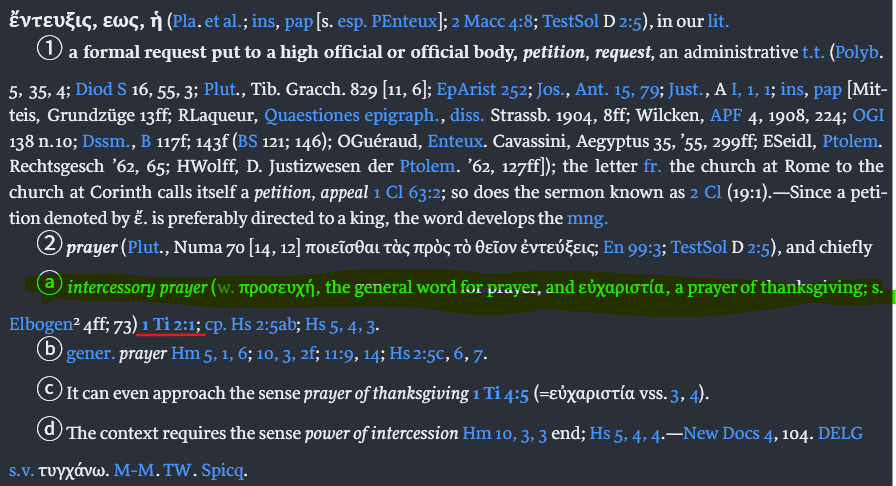
The only instance in the LXX is 2 Macc 4:8, which is not helpful, because it is a petition before a king—not a form of prayer.
In the NT, the two instances are both in 1 Timothy, 2:1 and 4:5,
|4| For everything created by God is good, and nothing is to be rejected if it is received with thanksgiving (εὐχαριστίας); |5| for then it is consecrated by the word of God and prayer (ἐντεύξεως).
The coupling here does not elucidate what is meant in 2:1. Rather, it makes it a bit more confusing because this seems to be generic prayer, and it begs the question, why was proseuchе̄ not used?
It is never wise to question why an author did not choose a word we might expect, but I believe this indicates, once again, the lexical overlap many of these words have. We have seen the first three used for generic prayer, so there may be nothing to glean from this usage in 4:5.
In the Apostolic Constitutions, there are recorded synagogal prayers, and one contains enteuksis,
Upon you the hopes of devout people have relied:
the Father of the blameless,
the Hearer of those who call upon you with honesty,
the one who knows the petitions (ἐντεύξεις) unspoken.
…
the incense that comes through prayer (προσευχῆς) and words is sent up to you.
(7:33, transl. from Charlesworth OTP)
Here, this appears to indicate just a petition or a request. The idea being, God takes care of the needs of a person, even if those needs are unspoken. So, there is not an idea of intercession.
The second instance occurs in the Letter of Aristeas, which is a “petition” to the king, not a prayer. Thus, here are two instances that show a closer meaning to deе̄sis.
In the Shepherd of Hermas, though, there is a clear and apparent usage of enteuksis as an intercessory prayer. The author describes how it is difficult for the rich to pray before God, so they are to take care of the poor, for their prayers hold more weight. As such, the poor would intercede before God on behalf of the wealthy:
…for the poor person is rich in prayer of petition (ἐντεύξει) and praise, and his or her intercession (ἔντευξις) has great power before God.
…and the rich person is continually concerned about the poor, that the poor may continue unceasing in life, for the rich one knows that the [intercession] (ἔντευξις ) of the poor is acceptable and rich in the sight of the Lord. (2:5, 6; transl. C. Osiek, Shepherd of Hermas: A Commentary, 161)
There must be distinctions in mind when Paul wrote 1 Timothy 2:1. Our first examination of deе̄sis is more clearly a petition before God. As such, it is unlikely that enteuksis is to be understood in the same way.
Rather, I offer that the meaning lies closer to what is in the Shepherd of Hermas. Paul is instructing multiple types of prayer on behalf of others, and I contend that the usage here indicates Paul wishes for the Church to intercede on behalf of others to God.
D. Thanksgivings | eucharistia (εὐχαριστία)
Eucharistia, just like the previous word, is relatively uncommon in the OT (4x), NT (15x), OTP (8x), and the Apostolic Fathers (7x, all instances in Ignatius except 1 in the Didache).
Eucharistia is used specifically for the Eucharist in Ignatius and the Didache, but is that the case for here in 1 Timothy 2 and the NT? As tempting as it may be to want this to be present in our current passage, that seems rather unlikely.7
But, generally, the term is used for showing gratitude or thanksgiving. Within the Pauline corpus, the term is coupled with prayer outside of 1 Timothy 2,
Have no anxiety about anything, but in everything by prayer (προσευχῇ) and supplication (δεήσει) with thanksgiving (εὐχαριστίας) let your requests be made known to God. (Phil 4:6)
Continue steadfastly in prayer (προσευχῇ), being watchful in it with thanksgiving (εὐχαριστίᾳ)… (Col 4:2)
Philippians has three of our four terms together, but the context does not begin to clarify the specificity of what the terms can mean. The broader examination of how the words were used in other literature has been more helpful.
Within the LXX, all instances fall outside of the Hebrew originals. 2 Macc 2:27 reads,
…just as it is not easy for one who prepares a banquet and seeks the benefit of others. However, to secure the gratitude (εὐχαριστίαν) of many we will gladly endure the uncomfortable toil…
The usage here is more generic having nothing to do with prayer or God. The term just reflects thanksgiving of guests at a banquet.
Wis 16:28, though, does link thanksgiving and God,
…to make it known that one must rise before the sun to give thee thanks (εὐχαριστίαν), and must pray (ἐντυγχάνειν) to thee at the dawning of the light…
The context of this statement concerns the manna from heaven for the Israelites. Here we see again a connection between prayer and thanksgiving to God, but the word for prayer here shares the root with enteuksis (ἔντευξις).
In short, the most likely intent here is to reflect the idea of giving thanks to God.
2. Syntax and Logic of the Passage
Now that we have generally established what the words for prayer are in the first verse, it is critical to establish the flow of the text. The RSV calls all of chapter 2 “Instructions concerning Prayer,” but that might be a bit misleading.
The entire section is not dealing only with prayer. I have highlighted my translation above to illustrate what is happening in the text: prayer > transition > creed > Paul’s mission.
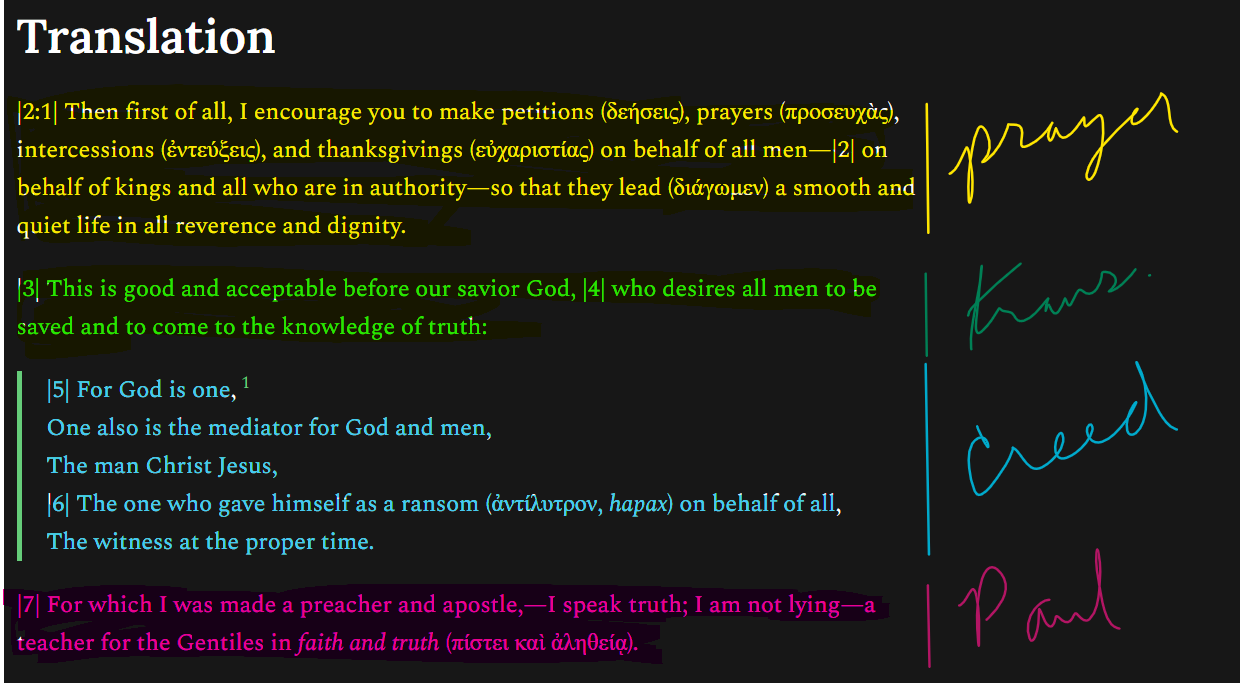
The yellow text relates to prayer, but the green material is a transition. V. 3–4 explains why praying to “God our Savior” is good and God’s desire for the salvation of all. This seems to trigger in Paul’s mind another topic: what is the “knowledge of truth” as it pertains to salvation.
Vv. 5–6 appear to resemble a creedal/catechetical/liturgical formula,8 potentially a quotation of what this truth on salvation is. And, it appears to play a game of word association.
One is God.9
There is One mediator between God and men,
That mediator is the man Jesus who gave his life as a ransom.
V. 7, in turn, is a personal note on how Paul relates to this truth.
V. 8 then speaks of prayer again. So, the verses that fall between vv. 2 and 8 are not about prayer. The use of “mediator” in v. 5 then has nothing to do with prayer; it instead concerns salvation and how it was brought about for all of humanity.
An Explanation of Prayer and Mediation
I have talked around the confusion of 1 Tim 2:5 by the very nature of discussing the meaning of these words for prayer and the structure of the passage. It is evident from the context that what is discussed in 2:1 is different from what is stated in 2:5.
In the first verse, Paul is instructing the need for the faithful to pray on behalf of others, especially leaders and the authorities. Whereas, in v. 5, this is a discussion of how salvation comes to humanity, via the death of Christ.
As such, Christ as the one mediator has nothing to do with the prayer of v. 1. The mediator role has to deal with salvation. Afterall, the petition in 2:1 is meant to request intercessory prayer on behalf of others to God for their salvation and well-being. We are all called to be intercessors, which does not certainly infringe on the mediatorial role Christ serves in v. 5.
It is worth noting that intercessory prayers, even for the dead, are not a Christian invention. This was seen above in 2 Maccabees and the Testament of Abraham,
|5| Abraham said to the Commander-in-chief, “Come, Commander-in-chief Michael, let us offer a prayer on behalf of this soul (ποιήσωμεν εὐχὴν ὑπὲρ τῆς ψυχῆς ταύτης) and see if God will heed us…”
…And Abraham said to the angel, “Where is the soul which you were holding in the middle?” 8 And the angel said, “It was saved through your righteous prayer, and behold a light-bearing angel took it and carried it up to Paradise.” (T.Abr. 14.5, 7)For if he were not expecting that those who had fallen would rise again, it would have been superfluous and foolish to pray (εὔχεσθαι) for the dead. (2 Macc 12:44)
These two examples show that there was this developing understanding within Judaism that prayers on behalf of the dead could have salvific ramifications.
Even within the NT, there is this idea that the prayers of the righteous could have salvific repercussions, and there is even lexical parallels to 2 Maccabees and The Testament of Abraham:
|14| Is any among you sick? Let him call for the elders (πρεσβυτέρους) of the church, and let them pray (προσευξάσθωσαν) over him, anointing him with oil in the name of the Lord; |15| and the prayer of faith (εὐχὴ τῆς πίστεως) will save (σώσει) the sick man, and the Lord will raise him up; and if he has committed sins, he will be forgiven.
|16| Therefore confess your sins to one another, and pray (εὔχεσθε) for one another, that you may be healed. The prayer of a righteous man has great power in its effects. (James 5:14–16)
There is a confluence of salvation, forgiveness of sins, and healing for this type of prayer: euchе̄. Though the root of this word is a permutation of proseuchе̄, which we discussed previously, it is related to what I classified as “general prayer.” In this context, it is hard to argue that there is not some idea of intercession with the presbyters.
James is specifically instructing for them to pray or intercede on behalf of others to God. This is not an instance of prayer on behalf of the dead, but it shows that intercession on behalf of the faithful is efficacious, akin to what we saw in the Shepherd of Hermas. There is even this idea that prayer by some is more beneficial than others; here, it is that of the righteous man.
This idea logically translated to prayers for the dead in Christianity, though, which we can observe in the NT apocrypha.
In the Acts of Paul and Thecla, Falconilla—a deceased girl—appears to her mother in a dream, and requests that someone pray for her so that she might attain eternal life,
Mother; let the young woman, Thecla, be reputed by you as your daughter in my stead; and desire her that she should pray for me, that I may be translated to a state of happiness… (8.5)
My daughter Falconilla, has appeared to me, and ordered me to receive you in her room; wherefore I desire, Thecla, that you would pray for my daughter, that she may be translated into a state of happiness, and to life eternal. (8.6)
When Thecla heard this, she immediately prayed to the Lord, and said: O Lord God of heaven and earth, Jesus Christ, thou Son of the Most High, grant that her daughter Falconilla may live for ever. (8.7; transl. W. Hone, The Apocryphal New Testament)
Though this text is a 2c. forgery, composed by a priest out of love for Paul (cf. Tertullian, de Baptismo 17),10 this document represents concerns of the time period. This story is a historical witness to Early Christian beliefs that prayers for the dead were effective.
M. O’Connor has an excellent article—“A Soul’s Second Chance: The Testament of Abraham and Traditions of Praying for the Dead” JSP (2026): 1–15—evaluating documents that mention prayer for the dead in earlier Jewish and later Christian literature.
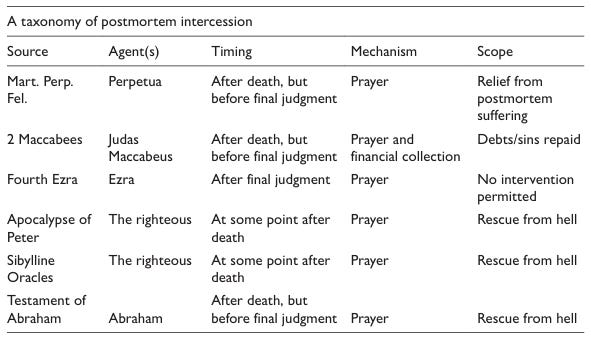
His overview of the texts, explanation, and evaluation of scholarship on this topic is superb and worth reading for a more detailed examination of this topic.
In all the passages we have explored, we see the intercessory importance for Christians to pray on behalf of others. Does this then infringe on Christ as the one mediator?
Obviously it does not since there is a distinction here between intercessory prayer and mediation of salvation. Praying on behalf of another does not detract from the work of Christ. Rather, conceptually, it is working in cooperation with this act.
Any and all prayer that is effective is contingent upon the ransom of Christ. To tie this back in to 1 Timothy, Paul instructed the necessity of prayer on behalf of others. It, in turn, is logical that Paul would discuss prayer and the salvific work of Christ. The two are intricately linked, for it is God who is our Savior. He accomplished this through his Son’s death, as Paul claims.
That then leads into Paul’s purpose: to preach this truth to other so that they, too, might be saved. The prayer on behalf of others, this intercessory act, is meant to lead to Salvation, which is made available via the death of Christ.
Conclusion
To pit intercession and mediation against each other in this passage is to miss Paul’s point entirely. The intercessions Paul wishes others to conduct is intricately linked to Jesus’s death for salvation.
1 Timothy 2 in no way denounces prayers for the dead or requesting the Saints in heaven to pray on our behalf. Rather, as the Church developed her thought on the Communion of the Saints, it is completely complementary to pray for and request prayers from those who have fallen asleep.
All are united in Christ by his death, so one must twist Paul’s meaning of intercession and mediation in 1 Timothy 2 to denounce prayer for/to the dead.
We see the importance of this practice as we explored in the literary history of Judaism and Early Christianity. This thought persisted also among the Fathers. Tertullian wrote,
As often as the anniversary comes round, we make offerings for the dead as birthday honours. (De Corona 3)
The Martyrdom of Polycarp also emphasizes the importance of saintly relics and honoring the deceased,
|2| And so later on we took up his bones, which are more valuable than precious stone and finer than refined gold, and deposited them in a suitable place.
|3| There, when we gather together as we are able, with joy and gladness, the Lord will permit us to celebrate the birthday of his martyrdom in commemoration of those who have already fought in the contest and also for the training and preparation of those who will do so in the future. (18.2–3, ca. AD 200, cf. C. Moss, "On the Dating of Polycarp"; transl. by M. Holmes)
This concept of praying to and for the dead is not even remotely prohibited in 1 Timothy 2. Rather, it is the germ for understanding communal prayer for all Christians, living or dead, for we do not cease to be part of the body of Christ when we fall asleep.
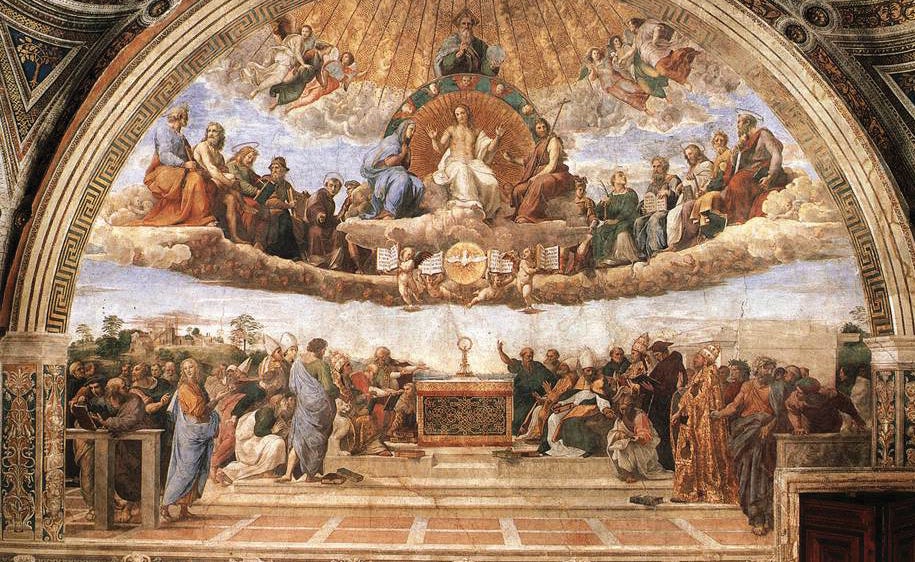
As a final note to go beyond the realm of historical-critical exegesis, it is in the Divine Liturgy or the Mass where this communion is truly achieved. It is a liturgical event—precisely in the Eucharist—where the earthly and heavenly realms converge for worship.
The intercessions and prayers of the living and the dead are made a reality in the worship of God and the re-presentation of Christ’s death, which transcends both space and time.
Prayers to or for the dead in no way contradict the ideas present in 1 Timothy 2. Rather, it is a natural extension of the concept because we are all called to pray and intercede for one another. If we truly believe there is no death in Christ, then requesting those who have already finished the race to petition to God is quite complementary.
If you have enjoyed this overview of prayer and mediation in 1 Timothy and wish to read more about the New Testament, would you kindly subscribe?

RSV, “For there is one God…”
I will not be discussing the authorship of the epistle. For convenience, I will be using “Paul”; if you wish to read more about the problem of authorship, see:

Contra R. Collins, 1 & 2 Timothy and Titus, 52:
As a result, the individual prayer forms suggested by the Pastor’s list are less important than the fact that the Pastor urges Timothy to pray in the best way possible.
Though, I do not completely disagree. I think there is this idea that Timothy is to pray in all forms and the repetition of nearly synonymous terms ramps up the importance. But, as I will explore in the following sections, there is some intended distinction here.
Alongside this thought, the prayer for the authorities is critical. Emperor worship was a problem for Jews and Christians, obviously, so praying to them was considering improper. As such, the instruction to pray for them was certainly intended to preserve the Christian communities. Additionally, this is why there is a monotheistic claim that follows the prayer.
C. Hutson, First and Second Timothy and Titus, 47 astutely notes,
We should not underestimate the degree to which monotheism challenged the ideology of the Roman Empire. The Jewish tenet that “God is one” carried with it the corollary that all other gods and pretensions of divinity were false, and that included the Roman emperor.
The phrase does not appear in the same position in the LXX, but it is retained in v. 3.
The note from Charlesworth OTP reads,
Note Abraham’s intercession on behalf of Sodom, Gen 18:22–33. On intercessory prayer as such, see AsMos 11:17; 12:6 (Moses on behalf of Israel); Ps-Philo, LAB 33:5 (effective only before death); 2En 53:1 (efficacy denied); 4 Ezra 7:102–15 (intercession at the time of judgment denied). This may be the earliest instance in Jewish sources in which intercessory prayer is considered effective after the death of the person on whose behalf it is offered. From later sources, see e.g. EcclR 4:1. See further E. E. Urbach, The Sages (Jerusalem, 1975) pp. 508–10 and notes. On intercession generally, see R. le Déaut, “Aspects de l’intercession dans le Judaïsme ancien,” JSJ 1 (1970) 35–57.
Contra J. N. D. Kelly, The Pastoral Epistles, 60:
As in 1 Cor. 14:16 f., we should probably see here a reference to the eucharist, which from earliest times was regarded as in essence a prayer of blessing and thanksgiving to God for all his goodness, from the creation of the world to the sending of his Son to suffer, die, and rise again for man’s salvation
Kelly, The Pastoral Epistles, 63 claims this is a catechetical or liturgical formula. M. Dibelius and H. Conzelmann, The Pastoral Epistles, 41, comment,
With respect to its form, this is not a “credal formula” or “confession,” but rather a liturgical piece, as style and content indicate.
Meanwhile, Luke Timothy Johnson, The First and Second Letters to Timothy, 191 rejects a quotation of tradition, creed, hymn, etc.:
In this verse, there is no reason to consider Paul’s statement as either hymnic/poetic or “traditional,” in the sense that it preceded the writing of the passage. It is, however, one of Paul’s typically compressed Christological-soteriological statements, as found also in Rom 3:21–26; 5:8–10; 1 Cor 8:6; 2 Cor 5:19–21; Gal 1:4; 2:20; Eph 5:2; Phil 2:5–11; Col 1:15–20; 1 Thess 5:9–10. For Paul’s declaration that “God is one”—hearkening to the shema Israel of Deut 6:4—see, especially, Rom 3:30; Gal 3:20; 1 Cor 8:6.
Most commentators comment on the oneness language here that resembles the Shema. There is not space here to cover this, but R. Collins, 1 & 2 Timothy and Titus, 60 summarizes the thought well,
Echoing the Jewish Shema (Deut. 6:4) and Paul’s hymnic confession (1 Cor. 8:6; see Gal. 3:20), the Pastor affirms the uniqueness of God. The confession of “one God” (heis theos)—the Shema proclaims “one Lord” (heis kyrios)—is a familiar topos in the apologetic literature of Hellenistic Judaism. There are not many gods and many lords; there is only one God, one Lord (see Eph. 4:4–6).
The emphasis on one God and one Mediator for salvation is a critical component of this section, for it is God alone who is savior. He alone saved humanity through the death of Christ.
“But if the writings which wrongly go under Paul’s name, claim Thecla's example as a licence for women’s teaching and baptizing, let them know that, in Asia, the presbyter who composed that writing, as if he were augmenting Paul’s fame from his own store, after being convicted, and confessing that he had done it from love of Paul, was removed from his office.”