
Re-Written Gospel
A Reflection on The Synoptic Problem, Inter-Gospel Hermeneutics, and Historicity

I mentioned in my John 3 article that I have been ruminating recently on Gospel historicity because a significant foundational element of that piece concerned the genre of John, historical reliability, and the author’s purpose in that pericope.

Historicity is a difficult topic; our standards, access to information, and styles are exceedingly different from the ancients. I have broached this topic in a three-part series on Luke-Acts and speechcraft.

When we examine the Gospels, it is apparent that there are differing details in the narratives of Christ’s life. Some of these cannot be harmonized, but is this a problem for historical reliability? As stated, the standards of now are not the same as then.
This difference, though, does not simply make the problem of historical reliability dissipate. The jarring paradoxes, inconsistencies, and differing details all point to a conclusion. An answer must be given to the inevitable question, are the Gospels reliable?
When we read the Gospels, they each tell a different tale; they all weave their own yarn. Each author has an intended purpose, and each wishes to convey different theological points than the others. There are congruencies, yes, (Jesus was baptized, had a ministry, was crucified, and rose from the dead), but we would have no need of 4 Gospels were they identical.
We also know without a doubt that textual sharing occurred,—a large percentage of Mark appears in both Matthew and Luke—but it is not apparent which came first and which followed chronologically. The literary connection between them is undisputed, though, and the analysis of how these documents are related is called the Synoptic Problem.
In this article, I will cover this topic briefly because it is foundational before we are able to explore the historicity of the Gospels. In turn, it is critical to establish the genre of these documents, for that dictates how they should be read and what is expected by the reader. Finally, I hope to reflect on the purpose of the Gospels generally.
Are they meant to be historical records? Do each of the evangelists have the same concerns and problems? Are we even asking the appropriate questions?
Nota Bene: This is an uncomfortable conversation, but it is one that is necessary. A coherent answer must be given to resolve these issues in a post-modern world. It is necessary to have an explanation why Scripture is a reliable epistemic witness to truth.
These inquiries and topics cannot be fully explicated in a single SubStack article, but I do hope to produce something that will prime the pump for later discussions.
The underlying thrust of this project, ultimately, is to re-evaluate the hermeneutical approach of the Evangelists when they composed their Gospels. The term I wish to use is Re-Written Gospel,1 based upon James Kugel’s work on re-written Bible.
The Gospel writers were all composing with literary works in hand,—some we have, some we do not—and they are re-shaping these sources to tell their own stories. This may appear tangential, but it is a critical component of assessing historicity: How were the Evangelists manipulating their sources to tell their story?
We know for certain that there was inter-dependence in composition, and this article will illustrate how these authors manipulated and changed these narratives to achieve their own theological ends. This ultimately culminates with a reflection on how this process impacted historicity and what inerrancy ultimately is for the Gospel narratives.
The Synoptic Problem
Before we can explore Gospel historicity and the other topics above, I think it best to discuss the Synoptic Problem: which Gospel came first, the dependency of the others in composition, and the literary relationship they all share.
Ultimately, the conclusion and reality are immaterial for my ultimate point because no one disagrees that the Gospels are copying each other, and there is certainly a reliance on other writings and/or oral tradition. Be that as it may, I want to display the 3 major views in the field—Lucan priority will not be discussed because it is the most unlikely situation.
The traditional explanation is called the Augustinian Theory, which holds Matthew was composed first, followed by Mark and then Luke—the canonical order.2
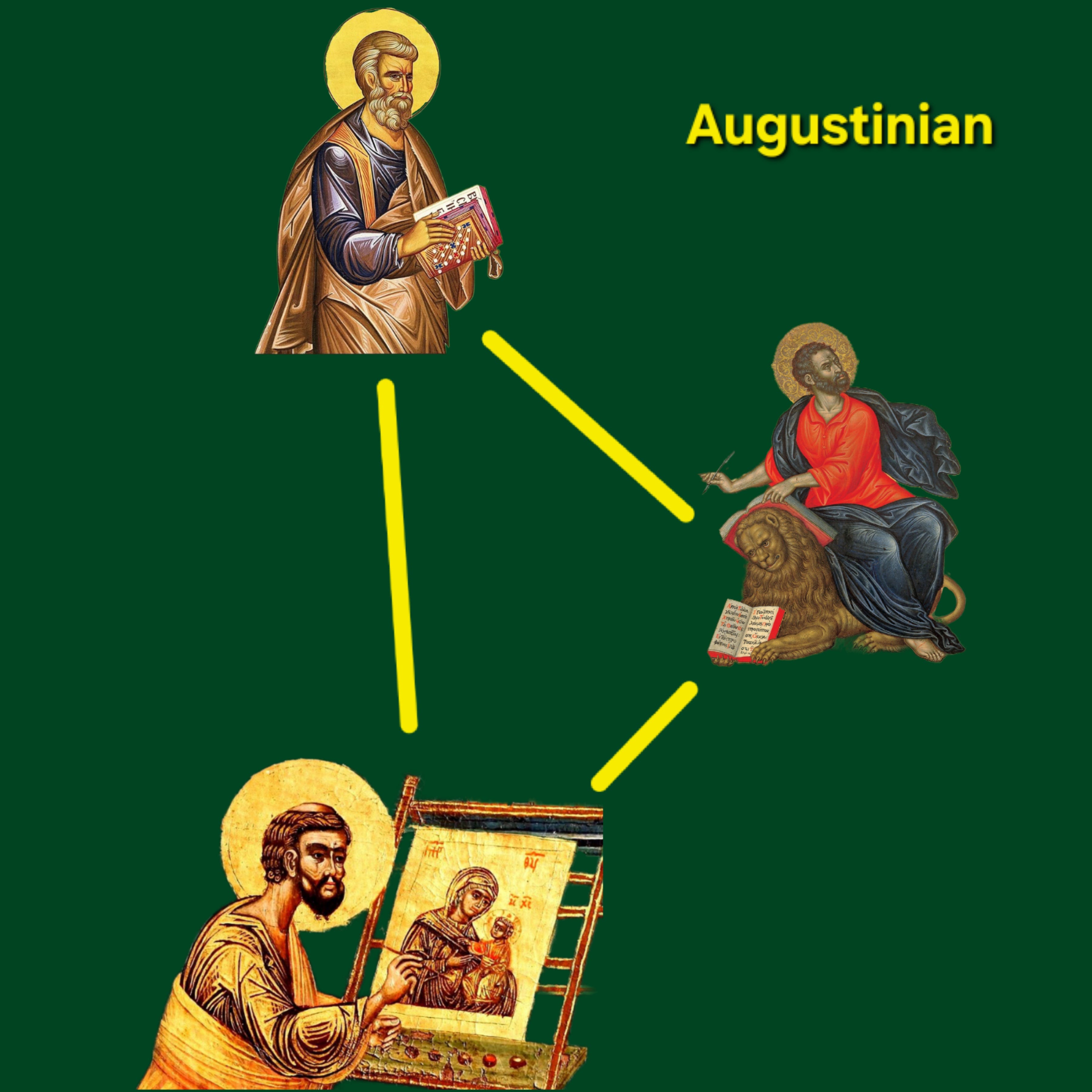
The scholarly permutation was posited by Johann Griesbach, which assumes Matthean priority, with Luke written next and then Mark.
The majority view in the academy is called the Two-Source Theory.
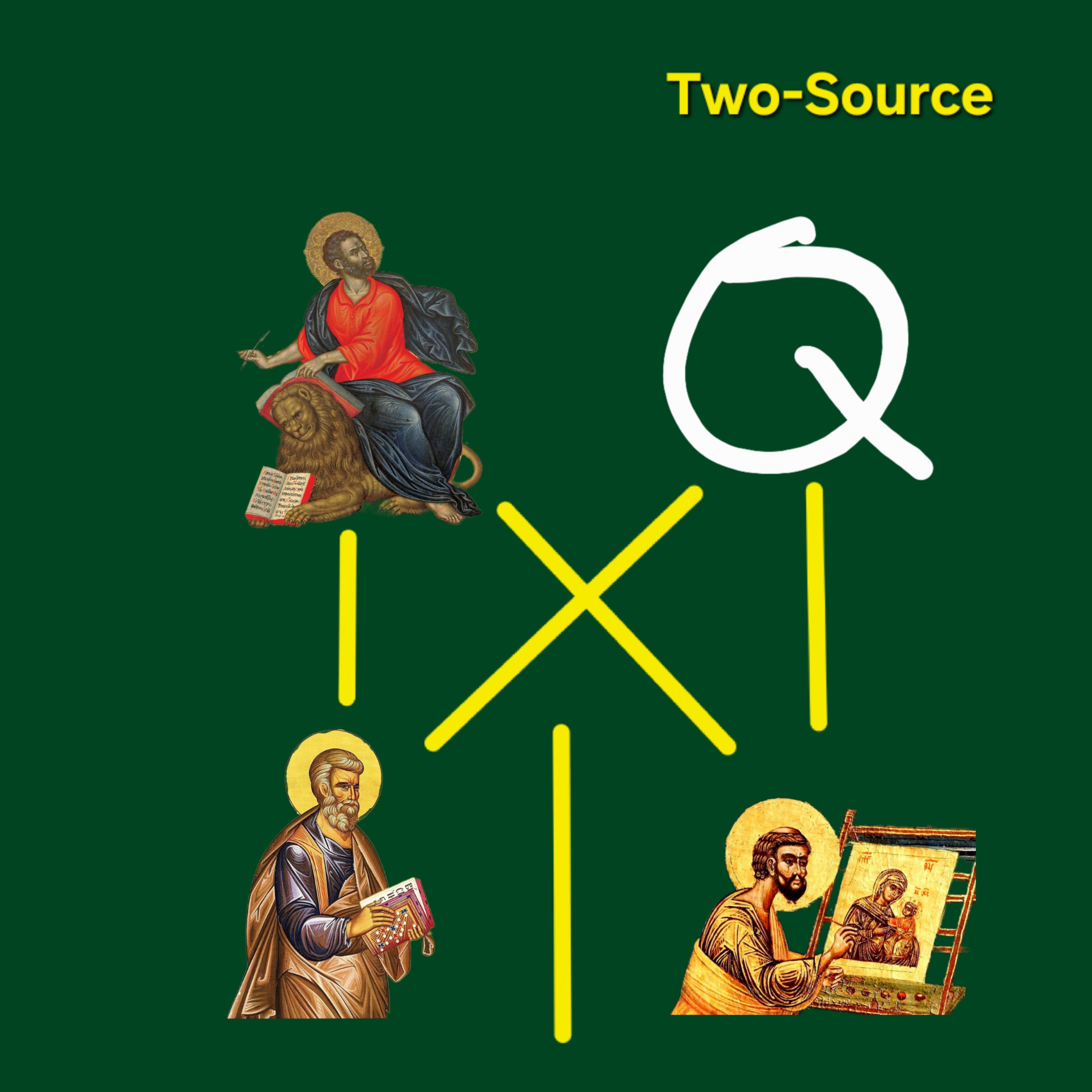
In this model, Mark was composed first, and there existed a sayings source, known as Q,—short for German Quelle, “source”—which has only been hypothesized. When the Gospel of Thomas was discovered, this document was believed to be Q since it was essentially what had been theorized. Today, this opinion has been abandoned. That said, it admittedly does strengthen the case for Q because a document of its kind was discovered.
Matthew and Luke, in turn, wrote having no knowledge of the other. They both use Mark and Q.
The final view was promulgated by Austin Farrer, and it has gained additional ground and prominence due to the work of Mark Goodacre—consult Goodacre’s book The Synoptic Problem: A Way through the Maze.
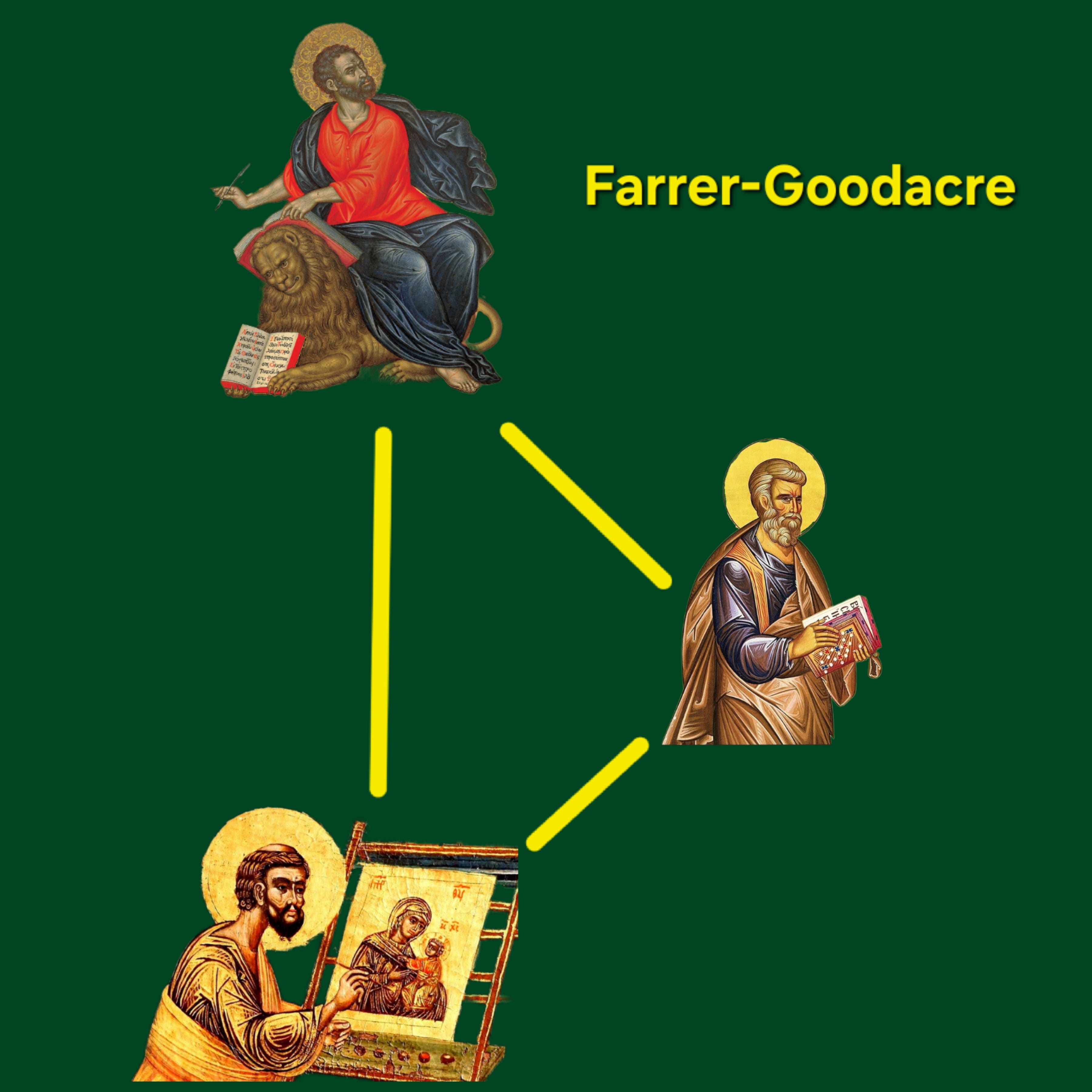
In this theory, Mark was composed first, followed by Matthew and then Luke, with each subsequent author possessing what was composed before him.
All positions assume John is the final Gospel to have been written.3
It is important to note, not one theory truly resolves the problem, for there are issues with each. These details will not be explicated in this brief examination, but I will be presupposing the Farrer/Goodacre theory.
Why? I do believe Mark was written first. Its brevity and more cryptic Christology are signs of an earlier record of Christ’s life. There are significant features missing such as a birth narrative, the virgin birth, and extended preaching discourses (e.g., the Sermon on the Mount/Plains).
This does not necessarily prove that Mark was written first, but the easier explanation from silence is that Mark did not have these narratives, whereas the later Gospels did. It is simpler to assume addition happened rather than extensive deletion.4
The Messianic Secret and the general cryptic nature of the Gospel contribute to my position. In many ways, the other Gospels appear to be amending Mark in order to clarify what he meant—more on this to follow.
I also am not comfortable with accepting the existence of a hypothetical document we have no concrete evidence for. Goodacre’s work—The Case Against Q—is compelling enough to cast doubt on the hypothetical document.
Finally, a major feature of the discussion centers on shared material. There are three main categories,
Triple Tradition—a story shared by all three
Double Tradition—two of the Synoptics share the narrative
Single Tradition—the pericope is contained in only one Gospel
These features will be impactful in the following section, where I wish to discuss how the Evangelists composed their Gospels, dependent on sources they developed and altered.
Re-Written Bible and Re-Written Gospel
In my most recent article, I briefly explored James Kugel’s discussion of re-written Bible as an Early Jewish hermeneutic for interpreting OT texts.

Kugel explains the hermeneutic as follows,
Retelling, it should be said, was actually the preferred form of biblical commentary in this period. That is, instead of citing a particular verse and explaining its meaning (as our modern-day, and some ancient, commentators do), Second Temple writers preferred to retell the text, substituting for a problematic word or phrase one that would be understood by all readers... This form of writing (Jubilees is only one example) has been termed the “Rewritten Bible,” but it was almost never a rewriting for rewriting’s sake; by retelling the text in their own words, commentators were able to explain things and eliminate any perceived inconsistencies or problems.5
He begins his chapter detailing that it is relatively unknown how precisely the Hebrew Bible was compiled prior to Christianity, explaining that various groups likely compiled parts together, which then led to a complete corpus later.
It must be remembered, the ancients did not conceptualize Scripture like we do today for various reasons. Accessibility, especially in the Ancient Near East, would have been non-existent for most. Mass production was an impossibility. Reading was not a skill everyone acquired. Communication was exceedingly more limited.
The documents we have preserved are significant, and they have withstood the test of time. But, that is not to say that everything we consider inspired now, was then, nor does it mean that these communities were not reading other documents that we do not believe to be authoritative. We see this in the first century concerning differences in various Jewish sects, e.g., Pharisees, Sadducees, and Qumran.

Later in the chapter, Kugel explains that the need for interpreters rose due to the inability of people to understand what had been written. The entire OT was not composed within 20 years. As such, those returning from the Babylonian exile were so far removed from when the Torah was written, there were words, phrases, and concepts that would have been wholly unintelligible to them, so an authoritative interpretation needed to be established.
We also see this, as Kugel points out, in translation, i.e., the Old Greek or Septuagint.6 There are many instances in which the varied translators took the liberty to interpret what they believe was happening in the Hebrew—an example of this can be found in my Matthew 16 article.

Additionally, perceived narrative contradictions needed to be reconciled, so interpreters undertook this task by explaining them in their commentaries, in their re-tellings of biblical events.
He brings a plethora of examples from the Old Testament Pseudepigrapha (OTP)—1 Enoch, Jubilees, Testaments of the Twelve Patriarchs, etc.—Qumran, and Philo to illustrate this developing hermeneutic.
In his conclusion writing on exegetical motifs, he expresses an important sentiment for what I wish to discuss concerning the Gospels,
There have been many interpreters since these first generations. Later Jewish and Christian exegetes built on the interpretations they received from their forebears. Patristic exegetes, thought they inherited the attitude to the text and a considerable body of interpretations from earlier times, created a highly developed set of typological and allegorical interpretations of their own; their writings ultimately led to the medieval doctrine of four levels of meaning in every biblical text (22).
Now, it may seem nonsensical to discuss Kugel’s chapter on re-written Bible for our current study, but I believe this hermeneutic aptly displays what is happening in the Gospels.
We will take my assumption that Mark was composed first in this article. As such, he created his narrative from his own thoughts, likely oral traditions, and there may have been other documents he had at his disposal. We may not have any of this confirmed in the historical or literary record, but it seems unlikely that he had nothing at all and generated the Gospel from nothing.7
In time, Matthew then composed his Gospel, relying on Mark, and then Luke decided to write his own narrative, reliant on both Matthew and Luke. Due to this literary dependence, they are shaping and re-working material in their own compositions.
We can see a window into this from Luke’s prologue (1:1–4),
|1:1| Inasmuch as many have undertaken to compile a narrative of the things which have been accomplished among us, |2| just as they were delivered to us by those who from the beginning were eyewitnesses and ministers of the word, |3| it seemed good to me also, having followed all things closely for some time past, to write an orderly account for you, most excellent The-oph′ilus, |4| that you may know the truth concerning the things of which you have been informed.
In the opening verses of Luke’s Gospel, we have a clear statement that he compiled evidence. V. 3 feels pointed, too, that he wants to create something “orderly,” implying others have done work that he believes needs updating, or the texts require explanation—interpretation.
There is no way to read this introduction and not assume he is in part referencing Mark and Matthew—at the very least Mark because he takes so much from his Gospel.
Because of this literary reliance, we can observe interpretation of these documents shortly after they were composed.
Evolutions of Mark in Matthew and Luke
In order to discuss re-written bible as an exegetical practice in the Gospels, it will be most apparent if we look at concrete examples.
There are instances in which Matthew and Luke either clean up something they do not like in Mark, or they wish to shift a theological emphasis. This is achieved in a number of different ways. A few of these tactics I want to explore include,
Alteration of Mark
Expansion of Mark
Deletion from Mark
Matthew and Luke are both working solidly with Mark as if it is their base text—the chronology is nearly identical, and the heavy reliance on Mark’s content establishes this. In turn, when Matthew and/or Luke diverge from Mark, there is a reason. It is not always apparent why, but that is the onerous task of the historian and exegete: explain why the change happened.
Our first example comes from the account of the “rich young ruler”—a convenient title contrived based on his differing descriptions in the Synoptics. Here, Mark presents Jesus saying something alarming that seems to denigrate himself:
|17| And as he was setting out on his journey, a man ran up and knelt before him, and asked him, “Good Teacher, what must I do to inherit eternal life?” |18| And Jesus said to him, “Why do you call me good? No one is good but God alone… (10:17–18)
In this instance, Matthew appears uncomfortable with Jesus excluding himself from being good, so he implements an alteration to Mark. Check the synopsis below:8
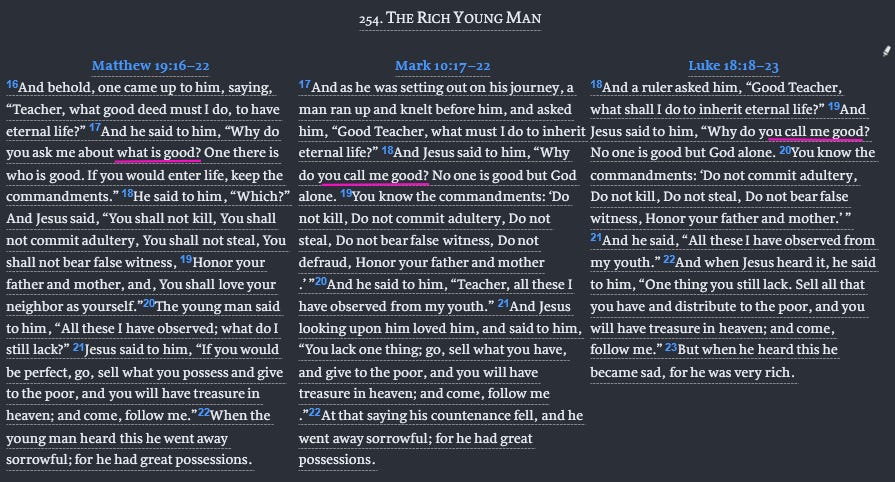
Matthew changes the man’s question, which results in a different response from Jesus: “Why do you ask me about what is good?” Why? The easiest explanation is that he was uncomfortable with how Mark framed the narrative. So, Matthew simply retells the tale in order to smooth over a potentially embarrassing detail in Mark.
Now, I will not delve into this deeply because it distracts from the point, but Mark does not imply Jesus is not “good.” He heals the man with the withered hand in 3:1–6, implying he has done “good,” a lexical tie that is critical for understanding this passage.
Joel Marcus has a convincing article on this topic, “Authority to Forgive Sins Upon the Earth” (1994).
As for discussing re-written Gospel, the alteration is done as an interpretive shift akin to the examples provided by Kugel of Second Temple exegetes. This hermeneutic of re-written Bible is precisely parallel to what is occurring here in Matthew 19. A word or phrase has been changed to smooth out a potentially problematic position.
The next example I want to highlight is Peter’s confession in Mark and Matthew. Matthew greatly expands the Marcan narrative, elevating Peter’s status among the apostles; the synopsis shows,
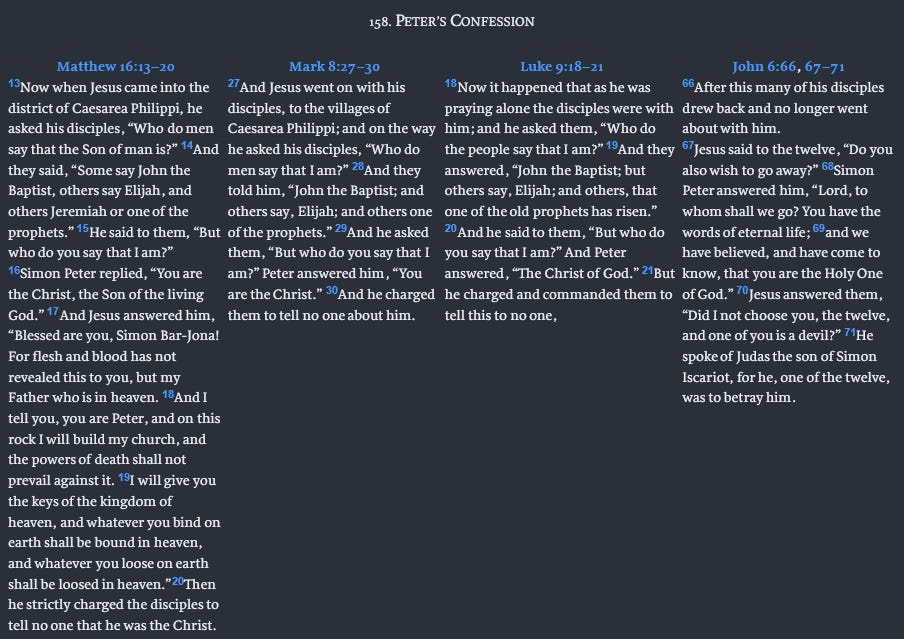
I have written an expansive article on this pericope in Matthew, so I will refrain from repeating myself here—link above. But, I do want to reflect on the why this occurred. Obviously, there is no detail in the text that explicitly states the purpose behind the elongation of the narrative. There also is no hint if this is a Matthean invention, if this is an oral tradition, or if there was a written document recording this material.
One can only speculate the source and the impetus. That said, based on what we have explored in re-written Bible, we can postulate that this is an interpretation of Mark. Matthew’s audience may have had allegiance to Peter or had a special interest in the apostle. Or, maybe Matthew just personally wanted to advocate for Peter’s prominent role.
There may also have been developing trends within the Church that caused Matthew to desire to put authoritative words in Jesus’s mouth in order to advocate for Petrine leadership in a unique way. It could be a further clarification concerning the successors of the apostles, that they have a special authority in the Church (cp. Matt 18:15–20 on binding and loosing).
We cannot say definitively why, but it is clear that Matthew made an interpretive expansion to Mark’s narrative.
Another obvious example is Jesus walking on water, and Peter’s inclusion in Matthew.
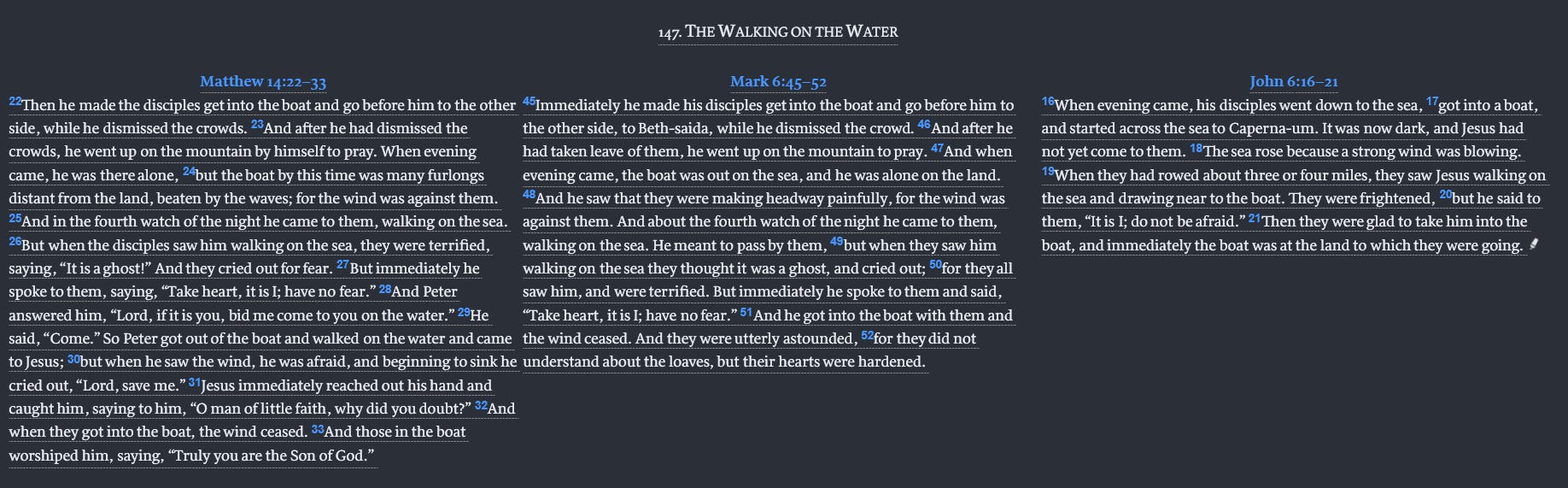
Here we have 2 examples of the three instances above: an expansion—Matthew—and a deletion—Luke. In this survey of re-written Gospel, we are not concerned with the exegetical explanation. I just wish to illustrate these features.
It all falls under a similar hermeneutic as re-written Bible. Mark is a base text that Matthew and Luke are amending for interpretive reasons. It is more complicated than what was occurring in the Second Temple Period because the impetus was different, but the exegetical practice is similar. By this, I mean they are writing—more than likely—before the death of the author whom they are copying rather than hundreds of years later.
In this third case, we have an example where Matthew felt compelled to say something about Peter and interpret further Mark’s Gospel. Whereas, in Luke, he must have felt the narrative was not as critical for his theological narrative—regardless, a shocking omission.
EDIT: 5 May 2026—an example I forgot to include.
Our last example will be the final words of Christ. Of the four Gospels, we have three exceedingly different records for Jesus’s final words.
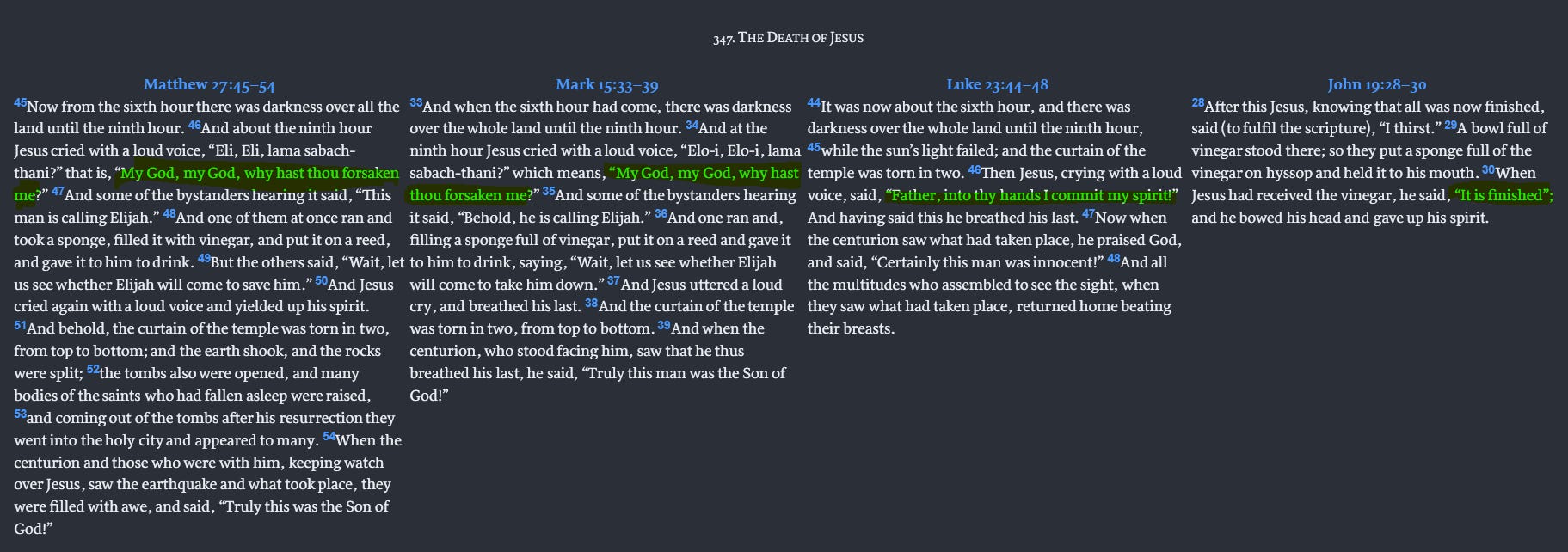
Here, we see agreement between Matthew and Mark, but Luke and John differ. So, we have examples of copying—Matthew—and alteration—Luke (and John).
These differences are significant for our analysis in two ways. First, each record cannot be historically accurate, and an attempt to harmonize will lead to a preposterous result. Second, these shifts are clearly for a narrative reason. Each author wished to have Jesus’s last words mean something significant for their own theological story.
Ultimately, we must remember that each Evangelist wrote for a purpose, and their decision to add, remove, or alter narrative details and events were done so to interpret who Jesus was as the Christ,—the Son of God—contingent on sources they are re-writing and interpreting.
The Gospels are more complicated than just simply stating they are a product of writing Mark with a twist. As I discussed in the Synoptic Problem section, 76% of Mark is shared between all three, but this makes up less than 50% of Matthew and Luke. Each Evangelist was constructing their own story.
As such, this idea of re-written Gospel explains only so much, but I do believe the hermeneutic of re-written Bible helps us understand what is happening when Matthew and Luke are adapting Mark. It is a way for us to reevaluate this material because these authors are potentially revealing how they understood the Second Gospel.
It is a means of interpretation while simultaneously incorporating a story into their own narrative. This is not an act of mere plagiarism.
This becomes apparent when comparing the similarities between Mark and John, especially in the shared narratives that the Fourth Evangelist expanded.
The Gospel of John as Commentary on Mark
The tide has been shifting in scholarship on the relationship between John and Mark. Previously, the majority view was that John had no knowledge of Mark. That view is becoming less popular.
In this final section on re-written Gospel, I want to show why I believe John knew Mark, and how he employed similar techniques to those found in documents like Jubilees and 1 Enoch—re-written bible.9
It must be kept in mind, though, that John is a different type of Gospel from the Synoptics. Mark, Matthew, and Luke follow nearly the same chronology, but John differs greatly. If John does borrow a story shared by the Synoptics, we do not see the same literary copying as we do with the others. As such, his re-written Gospel is a different type, but the general principle still applies: he is interpreting the stories that came before.
I will explore only one example to illustrate my point of re-written Gospel in John and Marcan dependence: The miraculous feeding in the Wilderness. I have written on the Feeding of the 5,000 in Mark and the Bread of Life discourse in John, if you wish to see my thoughts on these pericopes independently.


I have not explicated this connections in either work, but the discussion in John 6, I believe, is deeply contingent on the Evangelist’s reading and understanding of Mark 6:30–44 and a number of relevant pericopes.
First, I must establish that the Feeding of the 5,000 is meant to be Eucharistic, at least a foreshadowing of the ritual in the Last Supper based on lexical and syntactical features.
In my article on bread in Mark above, I argue that the Wilderness Generation and the provision of Mana in the Torah, the Psalms, and extra-Jewish literature is foundational for understanding the passage—really, all of Mark 6–8. Mark is not explicit that this OT type is present in the text like it is in John.
This OT narrative is meant to prefigure the Feeding of the 5,000 and ultimately the Last Supper/Eucharist.
My argument rests on significant internal parallels in the Feeding of the 5,000, the Feeding of the 4,000, and the Last Supper—the blessing and breaking of the bread.
And taking (λαβὼν) the five loaves (ἄρτους) and the two fish he looked up to heaven (ἀναβλέψας εἰς τὸν οὐρανὸν), and blessed (εὐλόγησεν), and broke (κατέκλασεν) the loaves (ἄρτους ), and gave them to the disciples (ἐδίδου τοῖς μαθηταῖς) to set before the people (6:41)
…and he took (λαβὼν) the seven loaves (ἄρτους), and having given thanks (εὐχαριστήσας ) he broke (ἔκλασεν) them and gave (ἐδίδου) them to his disciples to set before the people (8:6)
And as they were eating, he took (λαβὼν) bread (ἄρτον), and blessed (εὐλογήσας), and broke (ἔκλασεν) it, and gave (ἔδωκεν) it to them, and said, “Take; this is my body.” (14:22)
Notice in all three instances of the event, there is a genetic relationship: taking bread, blessing/giving thanks, breaking, and giving.
In Mark 14, the final phrase is key, “this is my body.” It is quite natural then to perceive the other two feeding miracles as anticipatory of the Last Supper, and the miraculous feeding of Manna in the Wilderness for the wandering generation is the prefigurement.
It is, in turn, logical to conclude that these are primitive images of the Eucharist in the ministry of Christ. But, this underdeveloped thought may not be as half-baked as one might think when considering Paul’s discussion of the Eucharist in 1 Corinthians 10–11,—he also relies on the Wilderness Generation—which I have explored in my John 6 article (above).

In our earliest attestation of the Words of Institution, we see these same features present, sans the giving to the disciples. Be that as it may, the persistent tradition centers around “this is my body.”
Now, as for re-written Gospel in John, I contend that John is fully aware of this feature in Mark. The Fourth Evangelist was writing most likely in the late first, early second century, and the Eucharistic rite had been practiced for decades, and with it, the concept of real presence was developing from as early as Paul.
When John recounts the Feeding of the 5,000, he retains the Wilderness Generation and the Manna prefigurement—contrasting it specifically in the Bread of Life discourse—while explicating what precisely this text signifies. Just as Jubilees takes narratives from Genesis and develops them for his own reasons, so John took Mark as a base text and put his sacramental thought into Jesus’s mouth in order to detail what he believed was happening in the rite.
In his own miraculous feeding, John has Jesus perform the ritual similarly,
Jesus then took (ἔλαβεν) the loaves (ἄρτους), and when he had given thanks (εὐχαριστήσας), he distributed (διέδωκεν) them to those who were seated… (6:11)
There is present the taking, the giving thanks, and the distribution. Admittedly, it is unfortunate the “breaking” is not present,10 but we have seen variation in the presentation already. What matters is the genetic relationship between all these presentations.
In a way, there are two levels of rewritten bible occurring. John is retelling the miraculous feeding account from the OT as anticipatory of Christ, as well as interpreting the germ from Mark and rewriting it for his own developed theological purpose.
John makes it explicit that Mark is working within a framework of the Wilderness Generation: “Your fathers ate the manna in the wilderness, and they died” (6:49). This dialogue following the Walking on Water account in the Fourth Gospel is interpretive commentary on Mark.
The appeal to the Exodus is not a creation by John; it is dependent upon Mark. He is explicating the OT foundation and presenting a eucharistic explanation of the rite in the late first, early second century. This is further underscored by Mark’s clear parallelism of the two feedings and the Last Supper. John, recognizing this connection, chose to have his Eucharistic discussion in chapter 6 because of the interdependence of these pericopes in Mark.
But, it may not always be interpretation or commentary that is occurring in an alteration. John intentionally shifts the day on which Christ was crucified. In the Synoptics, Jesus dies after Passover, but in the Fourth Gospel, it is on the day of Preparation, which precedes the Passover meal.

The why goes beyond the scope of this article,—I have written on this elsewhere—but briefly the intent is to make a theological statement: Christ is the paschal lamb.

This motif is not present in the Synoptic Gospels, so the narrative change is done to make a greater theological point (cp. 1 Cor 5:7). The author’s theological perspective drove him to construct the narrative in this way regardless of the strict historicity.
And, the development happened for the author’s own independent purposes. This is not an interpretation of Mark. John even felt comfortable contradicting the Synoptics—at least Mark.
In these narratives, the authors want to tell a story about Jesus in order to express their theology, so this must be kept in mind when evaluating the narrative inconsistencies, changes, contradictions, and expansions.
Thus, this instance is not an example of re-written Gospel. There is no interpretation or explanation occurring. Rather, he changed the narrative purely to make his own theological statement.
I think this distinction is necessary because not all evolutions of Mark, et al. fall under this hermeneutic.
When we understand all three Evangelists are working at some level with the other Gospels that came before, though, it becomes clear that there is exposition occurring in these writings. John is not just merely writing his beliefs, but he is supplying additional commentary on Mark, just like other Early Jewish authors did in their re-written bible accounts.
So, this ultimately leads to a discussion of historical reliability and what is truth.
Gospel Historicity, Genre, and Purpose
All three of these aspects of the Gospels are intrinsically linked. One cannot determine historicity if the genre has not been established, and it is impossible to understand purpose without locating the type of literature.
As such, it may be best to start with genre, for this situates the way in which a document should be read.
Genre: What is a Gospel?
Are the Gospels a unique genre of ancient literature that is particular to Christianity? In a way, yes, but this is a bit misleading.
The Synoptic Gospels are commonly understood to be Greco-Roman bioi (sg. bios). Graham Stanton, The Gospels and Jesus (2nd ed.), succinctly explains,
A careful study of the methods of the Greek and Roman biographers leads to a positive conclusion of some importance. Even though ancient biographers did not trace character development and rarely summed up their subject’s character in their own words, they were interested in the method of characterization. They allowed the actions and words of a person to speak for themselves. (17)11
This genre of literature traces the life of an individual, selecting stories that emphasize a characteristic(s). This can include unique birth events, epitomic virtues present from childhood, and heroic feats designed to illustrate the idyllic person. The narratives are heavily doctored to venerate the person.
We should be careful, though, to define the genre so narrowly and be aware of the limitations. The Gospels do not perfectly fit within this category, but it is a sufficient base with which to begin.
Recently, Jeremiah Coogan published a chapter—“Gospels and Other Narrative Experiments in the Roman Mediterranean”—problematizing the Greco-Roman bios for the Gospels. He notes that the explosion of bioi did not occur in the literary record until later,—e.g., Plutarch—and the set characteristics were not nearly as firm as has been assumed. He astutely notes,
Early narratives about Jesus… participate in this capacious network of literary experiments. My argument is thus not that gospel are sui generis. Much to the contrary, they occupy a vibrant literary field that shaped the expectations of early audiences… Narrative prose in the early Roman period is characterized by far more generic instability, experimentation, and innovation than gospels scholarship has acknowledged. (8)
Regardless of the precise label we place upon the books, it is clear based on the Synoptic comparisons, there are a number of characteristics to note:
These are not historical documents, meaning recording history is not the impetus
There is room for expansion, exaggeration, and explication
Fabrication is not off limits to illustrate a theme or perspective
Theological reflection and expression drive the narrative
Ultimately, these are theological stories or narratives. The Synoptics are generally the same in so far as they present stories about Jesus to convey aspects of who he was and what he accomplished. At times the narrative is meant to focus on a particular aspect of Christianity, e.g., discipleship, whereas there are also overarching themes that pervade the narrative and find their expression in multiple pericopes, e.g., Christology and soteriology.
Now, the Fourth Evangelist is rather different, as I have argued in my John 6 and John 3 papers, but I will not expound on that further here.
The Early Church even acknowledged this, as Clement of Alexandria represents,
But John, last of all, conscious that the outward facts had been set forth in the Gospels, was urged on by his disciples, and, divinely moved by the Spirit, composed a spiritual Gospel. (recorded in Eusebius, Eccl. Hist., 6.14.7)
I believe I have done a sufficient job elsewhere, but tersely, I understand John to be more similar to a Platonic dialogue than a Greco-Roman bios.
But, this is still not entirely accurate. A Platonic dialogue did not narrate the entire life of Socrates. Rather, it would be one event that was expanded into a lengthy dialogue with interlocutors. John, then, could be seen as categorically the same as the Synoptics with these philosophical dialogues injected into the plot.
Now, with the genre parameters established, what does that mean for historicity?
Historicity: Is the Theological Narrative Reliable?
Quite simply, these are not historical documents. There are significant differences in the tellings of Jesus’s life in the Gospels, so to conclude that they are strictly historical texts would miss the greater meaning of these works. Or, you must accept the contradictory nature of the documents.
For instance, the cleansing of the temple in the Synoptics happens at the end of the narrative just prior to the arrest and crucifixion of Christ, whereas in John, this event occurs at the beginning. In order to harmonize these differences, one would have to argue there were instances of this event. That is rather preposterous.
We then have minor glitches such as the color of Jesus’s robe at the mock coronation, scarlet in Matthew and purple in Mark. The significance of which pertains to the intent of each individual author, as I have written about here specifically concerning Mark:

One of the major chronological issues pertaining to the Synoptics and John is the number of trips Jesus makes to Jerusalem. Mark, Matthew, and Luke have Jesus travel but one time, yet Jesus enters the city on numerous occasions in John. What is most likely historical? This is difficult to determine, obviously, but John in my estimation presents a more probable scenario.
That said, the way in which Jesus teaches differs between John and the Synoptics. In Mark, Matthew, and Luke, Jesus speaks extensively in parables to cause confusion, while he also preaches, e.g., the Sermon on the Mount/Plains. John depicts Jesus as far more philosophical, speaking cryptically about theological developments from his own time. Which is more likely historical? I would wager that the Synoptics are closer to how the historical Jesus operated.
Does that mean there is a problem of historicity in the Gospels? Well, that depends. Is this question even appropriate to ask? If it is understood by the audience that these are documents written to convey primarily theological thought, the historical reality is only secondary. It is just a vehicle to transmit the author’s beliefs.
This is more abundantly obvious in John as I have argued, but I do believe each Gospel suffers from this dilemma. Not each and every detail or pericope is confined to a strictly historical event. I do believe that much of the Gospels are rooted in reality, but to say that every word and letter are meant to be taken as factual betrays what the Gospels are.
Purpose: Why Compose a Theological Story?
This, in turn, leads to purpose. What was the intent of the Gospel writers? To put it simply, it is to detail who they thought Jesus was—in the words of Peter, “You are the Christ.”
In order to explicate this description, each of the Evangelists had their own idea of who Jesus was, and they chose to highlight different features of his mission and what he meant for the salvation of the world.
There are obviously other topics of importance, e.g., discipleship, the church, ritual, etc., but each of these concepts ultimately orbit the conversation of who is the Christ.
This purpose, as such, is the most critical aspect to understand, not historicity. If we focus too much on what must have been, we will lose the forest for the trees. We should, rather, analyze each Gospel on their own and then compare that perspective with the others, understanding that Gospel inter-dependence is critical for comprehending aspects of these works.
Once we set all the Evangelists at the table, allow them to speak for themselves, and then put them in conversation with one another, we are, in turn, more capable of appreciating each for what they wished to convey. This can later lead to a more coherent theology, a step that proceeds the exegetical process.
Concluding Thoughts
For the faithful, a solution must be given for these paradoxical occurrences in the Gospels. I will not delve deeply into the conversation of infallibility or inerrancy for the NT; this article has not the space for it.
But, if we are to hold these beliefs, it is critical to specify what we mean by them. On a historical or narratively cohesive level, we must conclude that these terms cannot apply. The writers do not agree in the strictest sense of historicity.
This should not be troubling, nor should it invalidate the claims within these Early Christian texts for a number of reasons.
First, as we discussed, that is not the purpose of these documents. The impetus more is to say something about Jesus’s significance for humanity, as well as put forth who he was. This goes beyond history. It is commentary.
Contrived narratives such as the conversation between Jesus and Nicodemus in John 3 are intended to give an explication of a belief—here, the significance of Baptism. As for expansions, the extended dialogue concerning the Eucharist in John 6 is meant to provide a sacramental theology for a critical rite in the economy of Salvation. One a narrative creation, the other an expansion, both are authorial reflections on the life of Christ applied to the evolving Church.
If this is a standard hermeneutic of the Second Temple Period, the impetus is commentary, not history. Therefore, the expansions and creations should not be perceived as historical inaccuracies, for that is not the purpose.
The motivation lies outside of history, so to claim inerrancy is compromised would be problematic. As such, narrative shifts and changes between the Gospels are equally interpretive or explanatory for that particular Evangelist’s message; these cases of re-written Gospel again lie outside of the scope of history.
Second, perceived imperfections in a text should not lead to disqualification. This is especially the case when we consider the broken vessels God has used through Salvation History, e.g., a murderer like David or a liar like Abraham.
Statements and phrases, though seemingly said in error or with the wrong intentions can be the truth unknowingly. For instance, in John 11, Caiaphas is unintentionally prophetic,
|49| But one of them, Ca′iaphas, who was high priest that year, said to them, “You know nothing at all; |50| you do not understand that it is expedient for you that one man should die for the people, and that the whole nation should not perish.” |51| He did not say this of his own accord, but being high priest that year he prophesied that Jesus should die for the nation
Through bad intentions, prophecy is spoken.
And this understanding, in part, is required to have Jesus become the Messiah. When Isaiah and the Prophets wrote, they had no concept of Jesus. They wrote their prophetic messages with no knowledge of the incarnation. Their prophecies were intended for their time, but due to developments, they became applicable in the first century.
Without the hermeneutical and theological developments that occurred in the Second Temple Period, a historical-critical reading of Isaiah would not result in Jesus as the Christ. We as Christians must realize that God is the God of History, and he works within evolutions to achieve his ends.
History, literature, prophecy, and thought is not nearly as stable as we might think or desire. Over the course of thousands of years, we must realize the fluid nature of the literary and historical records we possess.
As such, any consternation we may feel when evaluating these uneasy results, should be assuaged by the reality of how Jesus became Lord within a literary tradition. It is through re-written Bible and historical & literary developments that such interpretations could have been accepted, and it is via re-written Gospel that Jesus tradition was able to further evolve to arrive at theological truth, to the meet the needs of ever-evolving ecclesial communities.
We develop our doctrines, our Faith, and our customs through similar means. The trinity and the hypostatic union, for example, are not explicitly taught in Scripture, but by reason and philosophy, the doctrine developed in order to reveal divine truth.
The purpose of this article has been to track a number of topics that culminate into an understanding of how we understand historicity in the Gospels. It is a far more complicated answer than everything is correct or there are errors, so the Gospels are suspect.
Rather, we must appreciate the Gospels for what they are. They are theological records, stories, narratives, and contrivances about the life of Jesus, meant to convey divine truth. This means that the purpose far outweighs the historical accuracy of what was recorded. As Coogan, “Gospels,” comments, “the experimental literary landscape of the Roman Mediterranean prominently thematizes questions of truth and fiction” (8).
The Gospel writers did not work with strict categories as we might assume today. We must also accept to some degree that fallible hands created these texts.
How we talk about and interpret these events transcend history and plumb a more convoluted subject, and this must be kept in mind when processing the words of the Evangelists.
When we think about “God-breathed” Scripture (2 Tim 3:16), does that mean historically perfect? For me, no, that cannot be the conclusion as per the examples above. When we discuss the sacred or divinely inspired, the inerrant truth must not pertain to these details. Rather, it is the revelation of God that must take center stage. As for 2 Timothy, inerrancy is not even the topic of the phrase, as I have shown.

The Word of God was still transmitted to humanity through the hands of imperfect humans, and the result is not exact precision in what we might assume or desire.
Rather, Scripture is a corpus of literature that was not planned out by any one person. The numerous authors composed over thousands of years. There was no roadmap for what was to be written. In fact, each text for Christianity has multiple levels of meaning and importance.
The confluence of all these ideas and readings come together to reveal perfection in the God-man Jesus. These records are not to convey historical truth but divine revelation. Once we appreciate this reality, the Gospels can then work as they were intended, to reveal the identity of who Christ was for humanity now and forever, not a bland historical account of what was.
If you have enjoyed this discussion of re-written Gospel and historicity in the Gospels, would you kindly subscribe?

When first writing this article, I believed that I was coining a new term, but while discussing the project with a friend, he alerted me to Jonathan Potter’s book Rewritten Gospel: The Composition of Luke and Rewritten Scripture.
Since the volume is published by DeGruyter, the $116 price point will prevent an extensive analysis of the work at the moment. The preview of the book, though, shows that we are approaching the discussion similarly.
Irenaeus explains,
Matthew also issued a written Gospel among the Hebrews in their own dialect, while Peter and Paul were preaching at Rome, and laying the foundations of the Church. After their departure, Mark, the disciple and interpreter of Peter, did also hand down to us in writing what had been preached by Peter. Luke also, the companion of Paul, recorded in a book the Gospel preached by him. Afterwards, John, the disciple of the Lord, who also had leaned upon His breast, did himself publish a Gospel during his residence at Ephesus in Asia. (Ad. Haer. 3.1.1; transl. Roberts and Rambaut).
There are some who believe that John was written much earlier, but this is a fringe position.
This is obviously extremely reductionistic. In most cases, it is assumed that additions are more likely than subtraction in these cases. This does not prove anything, though, since in this model Matthew and Luke both had Mark, and they chose to delete pericopes from Mark’s Gospel when composing their own.
“The Beginnings of Biblical Interpretation”, in A Companion to Biblical Interpretation in Early Judaism, 11. See also his monograph, The Bible as It Was, for a lengthier explanation of this concept.
And, not to be overly simplistic, the recensions correct some of these interpretive decisions to better match what was in the Hebrew.
I will not be taking Irenaeus’ (Ad. Haer. 3.1.1) record of Mark being a companion of Peter as historical in this article. There is no internal evidence in the Gospel that this was the case, and there is no way to definitively prove he was correct on authorship here.
The screenshots of the Gospels synopsis come from the Logos version of Kurt Aland, Synopsis of the Four Gospels.
This is not to say that John is necessarily conscious of his hermeneutic. Meaning, I will not be arguing that John is consciously attempting to emulate those other authors. This style of exegesis was so prevalent, though, that the Fourth Evangelist naturally interpreted Mark in this way and composed his Gospel in light of it.
This is a significant detail in Luke, where it is at the breaking of bread—a eucharistic image—when Jesus reveals himself to some disciples on the Road to Emmaus (24:13–35).
In this chapter, “What is a Gospel,” he examines numerous perspectives on what scholars have said about the genre. The older opinion that the Gospels were a unique genre or category is unhelpful.
This a substantial article loaded with layers of detail. I had to look up 'pericope' and how to pronounce it! I'm bookmarking this one for a more thorough read later today.